





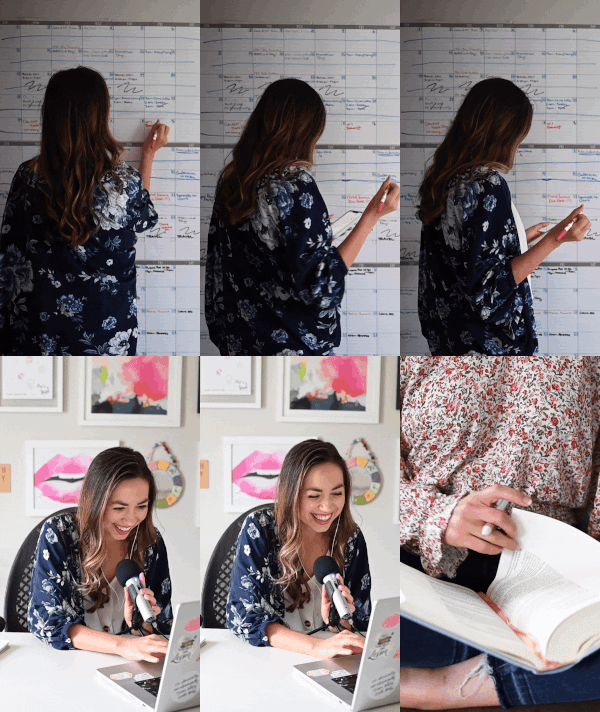




I’m back after a little planned two-month break from airing new episodes, and I’m so excited to be sitting behind a mic again recording. And I’m not just back with new episodes — I’m back with a series celebrating 10 years in business. What a milestone.
To celebrate, this month I’m sharing my biggest takeaways from these 10 years. I have some really fun episodes planned, but to start, I’m sharing 10 things I’ve learned in 10 years of business and multiple millions of dollars in revenue. These are the pieces of wisdom I’ve gleaned over the past decade, and I’d love to pass them on to you — wherever you are in your business right now.
Maybe you’re just thinking about starting a business, freelancing on the side, or maybe you’re five, 10, 15, even 20 years in yourself. Regardless of where you’re at, I think there’s something here that can help.
LISTEN TO THIS EPISODE NOW:
Subscribe & download the episode to your device: Apple Podcasts | Spotify | YouTube | iHeartRadio
Search for episode 330 and 331!

Okay, so I have officially been in business for 10 years, since March 29th, 2016 (when I first posted on Instagram and Facebook, launched my website, and declared to the world that I had a business and was open).
Back then, my business had a totally different name. I’ve actually changed my business name three times in 10 years, ultimately landing on Elizabeth McCravy as my name. Before that, I had two fictitious, made-up names. And on day one, my offering was graphic design and website design services, along with social media management (kind of a hodgepodge, catch-all of things related to media, design, and marketing). I was basically like, “I can do it.”
Now, I primarily offer Showit templates and courses. I started out doing a lot, and over the years I’ve really honed in.
Before we get into the tips, I want to share a few things quickly.
In 10 years, I’ve done some things and I’ve made some mistakes.
When I look back, I’ve:
- Created two really big, exciting courses.
- Designed over 30 website templates
- Worked one-on-one with well over 100 clients for website design, branding, and social media management.
- Spoken on big stages
- Guested on podcasts
- Recorded over 300 episodes of this podcast
- Won awards
- Made multiple millions of dollars
- Started a real estate business with my husband using money I made from this business
- Had three babies and taken three maternity leaves
- Run a multiple six-figure business each year for a long time now, and built a business where I’ve been able to actually pay myself.
So there have been a lot of wins. I feel really proud of those things, and really grateful.
But I’ve also made big mistakes. I even thought about doing an episode in this series just about the biggest mistakes I’ve made over the past 10 years. I’ve
- Made bad purchases that were horrible business investments
- Hired and fired poorly and mishandled that process at times
- Launched products that completely flopped
- Posted things on Instagram that got no likes… or that people didn’t like
- Embarrassed myself and have done things that felt embarrassing
- Experienced burnout
- Had tax disasters (if you’ve been a long-time listener, you might have heard me talk about that!).
- Designed website templates that didn’t sell and eventually just took them down because no one bought them
- Said yes to opportunities I shouldn’t have
- Started things and closed them quickly.
There are so many more errors over the last ten years, too. I could do a whole episode just on mistakes and “failures” I’ve had and made over the last decade in business.
Read more: Why I Closed My 170-Member Paid Membership (+ My 3 Biggest Membership Mistakes!)
So with all that said, I’m coming to you in this series with these tips as a real business owner, a wife, and a mom, who’s done some really good things and also done some things that didn’t work out.
Who am I to share this business advice?
If you’re completely new here, this is just a quick recap. I’m Elizabeth McCravy. If you’re wondering what I’ve been doing these past 10 years: I’m a website designer and business educator. The main thing I do is sell Showit website templates, and I have online courses that teach things like podcasting and how to build a design business.
I’m also a mom of three small kids and a wife: my husband and I have been married for 10 years now. We actually got married, and then I started my business just a few months later. If you’ve ever heard that story, it all happened pretty quickly after we got married.

I’m a Christian, and I love sharing candidly what works and what doesn’t work for me. When I think back to episode one of this podcast, that’s really what I’ve been doing since day one with this show, Breakthrough Brand, sharing what works and what doesn’t, in hopes that you can learn from it.
1. Don’t Be Too Busy Building a Successful Business That You Forget To Build a Life
Don’t be so busy building a successful business that you forget to build a life. Your business is not the most important thing. It’s not who you are. It’s something you do.
What I mean by that is: build your business around the life you want, instead of fitting your life around your business and making your business the thing everything else has to work around.
Nothing about your business is more important than your family, your children, your faith, your friendships, your health. Have rightly placed priorities in your life.
I love the quote from Stephen Covey: “The main thing is to keep the main thing the main thing.”
It can be so easy, I’ve felt this at times, to get caught up in business, the hustle, the desire to do more and achieve and compete, that you neglect other things. And I’ve seen this happen to people without them even realizing it.
You get more wins. One win after another. You’re earning well. You want more and more and more. The “more” is never enough. You start achieving for the sake of achieving, and you sacrifice your life and your other priorities at the altar of your business.
So avoid this mistake.
One way to avoid it is to simply be conscious that it’s something that happens. Be aware enough that you don’t let it creep in and become one of the many, many successful entrepreneurs—I don’t even have to name names. If you’ve listened to podcasts or consumed content from big creators, you’ve heard the stories. They built massive businesses, but along the way they lost their marriage, neglected their health, stopped nurturing friendships, or missed the little years with their kids.
Those are common stories we hear from people who’ve built really, really big businesses. And while they’re building them, you often don’t see what’s happening because it doesn’t look that way from the outside. But then later they’ll tell you, “Hey, I was a gazillionaire, but I got really unhealthy during that time,” or whatever the thing might be.
So I would just say: keep the main thing the main thing. And I would argue the main thing isn’t your business.
Build a life. Fit your business into your life. Don’t chase success for the sake of success. That could honestly be its own whole point. There’s so much wisdom in eventually asking yourself, what is enough?
For a while, you just want to keep growing. But at some point you have to ask: What’s my “enough” number? What do I want to pay myself? What does the business need to make in order for that to happen? And let that be the goal—not growth just for growth’s sake.
Practicing this in my own business right now
Since becoming a mom, I’ve had more intentionally placed priorities. My business has become less so that my kids can be more.
Right now, my youngest, Sofia, is seven months old as I’m recording this. I’m her primary caregiver. We don’t have childcare for her. I’m recording this podcast while my husband is with all three kids, but I’m their primary childcare and that’s what I wanted. I wanted that so badly. The more kids I had, the more that desire grew.
So I had to figure out: How do I keep the business I love and want to keep, while also having rightly placed priorities? How do I make the main thing the main thing?
I’ll talk more about that another time, but this has been a huge lesson over the past 10 years. I wish more people early in their business journey could keep this in the back of their minds. As you grow and build, keep asking yourself: Am I building my life around my business? Or is my business built around my life?
If you adopt that mindset early, you won’t run into as many issues. You’ll naturally build your business around your life instead of the other way around.


2. Just because you can doesn’t mean you should
Your life as a business owner will be littered with opportunities and the more successful you become, the more those opportunities grow. But they’re always there. From day one to year 10, there are always so many things you could do.
There are more events you could speak at, more podcasts you could guest on, more clients you could work with, more course ideas, additional business ideas. Someone’s always telling you, “You’d be the perfect person to create this product, please make it.” There’s a book you could write, a membership that sounds like a great idea, YouTube you could start, another podcast you could launch.
There are opportunities everywhere.
And there are people everywhere telling you what you should be doing, “You should be on YouTube. You should start a podcast. You should create a course.” There is always more.
But a lot of these opportunities are just distractions dressed up as opportunities, and you have to ignore them. Just because you can doesn’t mean you should.
If you fail to ignore distractions, you’ll end up burnt out, overworked, or maybe even less successful because your business lacks focus.
Just because you can do the cool thing doesn’t mean you should.
My advice here is to use discernment and discipline in your business.
Discipline, truly, to not say yes to everything. To pause and ask, “Is this actually a yes? Or is this a no?” Just because something sounds cool doesn’t mean it has to be a yes.
I love the quote from Warren Buffett: “The difference between successful people and really successful people is that really successful people say no to almost everything.”
There’s nuance to that, of course, but I do think there’s truth there.
Another quote I love, I’ve shared this on multiple podcast episodes, is something I heard from James Clear. He made this passing comment on Tim Ferriss’s podcast years ago, maybe six or seven years ago, and it stuck with me.
He said, “Success generates opportunities and distractions.” And he also said something along the lines of, “you get really good at something, so that brings opportunities your way. Then you turn around six months later and you don’t have time to do the thing that made you successful in the first place.”
Read more: Launching an Unaligned Offer: 8 Lessons Learned from Closing My Membership After Only a Few Months
3. Be Unrealistic With Your Dreams
As I was preparing for this, because this really is such an exciting milestone, I looked back at past episodes I’ve done like this. Over the years, I’ve recorded episodes sharing lessons learned three years in, four years in, and so on. In fact, on episode 60 of this podcast (six years ago!), I shared what I had learned four years into business. I think I gave four pieces of advice, and this was one of them.
It was actually so fun reading what I wrote back then thinking about myself six years ago in a completely different season of life. I didn’t have kids yet. My business was in a different place. I wasn’t making courses.
And yet, this advice feels even more true to me now than it did then.
I truly believe one of the keys to success is being the least realistic person in the room. You have the ability to dream and envision really big.
This is something I’ve lived by. I said it six years ago, and I’ll say it again now. I don’t want to live a realistic life. I’m not aiming for realistic and simple. From day one of my business, I’ve dreamed unrealistically.
My dreams have changed in big ways as my life has evolved. Becoming a mom completely shifted what I wanted my work to look like. But even then, what I’ve wanted has still been somewhat unrealistic. It hasn’t followed the conventional narrative of, “If you become a mom and still want to work, this is what it has to look like.”
I’ve just kept dreaming unrealistically.
And I think that’s important, because the mainstream way of doing things isn’t necessarily the best way. With this tip, I can’t recommend enough the power of journaling, letter writing, and vision casting for your business and for your life.
This has been a huge key to my success in creating a life I truly love and a business I truly love: spending intentional time envisioning what I’m actually after.
For me, and if you’ve been around the podcast for a while, you know this: I’m really into journaling. Sometimes this literally looks like sitting down with my journal and writing pen to paper. Other times, I like to go on a walk and just dream while I’m walking. I’ll put my AirPods in, but I won’t listen to anything. I’ll just think and pray and dream about my life, my business, or a project I’m working on. I’ve even done that with my births (literally going on walks while pregnant and thinking about my hopes, dreams, and prayers for the birth experience).
So I really believe in taking time to vision out what you’re after. I like to ask simple questions like, “If this were the best year ever, what would happen?” Just that question alone can open up so much. You can actually go back to episode 328 of this podcast for that full journaling exercise writing a letter to yourself from the end of the year, looking back as if it was the best year ever. It’s such a fun exercise if you enjoy journaling.
I would just say: vision cast for your life and your business. Dream bigger than what you’ve maybe been told is reasonable for you.
And to be clear, when I say dream bigger, I don’t necessarily mean dreaming about a $5 million business, traveling the world speaking at conferences, owning 100 homes, or becoming a celebrity.
If that’s what you want, then sure, that can be what dreaming bigger means for you. But dreaming bigger might also look like something that feels small to others but is still challenging and meaningful to you.
It might mean dreaming of staying home with your kids while maintaining income through one or two focused workdays each week. It might mean mastering something in your own business and teaching others how to do it. It might mean starting a podcast and creating episodes that impact people’s lives.
As entrepreneurs, you get to dream differently than if you chose a traditional nine-to-five path. You get more nuance, more integration, more freedom to build something that looks different.
Right now, I’m recording this episode in my messy home office, which also doubles as an art closet for my kids, in casual clothes, and I’m going to have to pause in a few minutes to nurse my baby. That’s what work can look like in entrepreneurship. It doesn’t have to fit into a traditional box. It can look a little unrealistic. A little different.

4. Have Fun With It
If you’re not having fun at least some of the time in your business, something might be off. Either you’re approaching it in a way that’s draining you, or you’re in a season that needs adjusting.
Now, I get that there are seasons of burnout. There are days where you think, “I don’t want to do any of this.” That’s normal. I’m not talking about a bad day. I mean overall, generally, your business should have elements of fun, curiosity, and enjoyment.
I would love to see you enjoying your business. That doesn’t mean you’ll love every task. It doesn’t mean it’s easy. But it can be fun and challenging and rewarding and exhausting and confusing all at once. That’s part of what makes running a business special.
So as you’re listening to this, maybe you’re on a walk, driving, doing chores, or working on your computer, ask yourself: Is there something you could do this week to make your business more fun?
Is there something you used to enjoy doing that you outsourced but might want to bring back?
Keeping joy in your business is important, especially if you want to stay in business for a long time. If you want it to be something you get to do, not something you have to do. That mindset matters.
There’s a quote I heard about 10 years ago from James Wedmore (someone I learned from early in my business). I’ve even been on his podcast, which was one of those big highlight moments for me. He said, “I’m not saying building a business is easy, but making it hard doesn’t mean you’ll be successful.”
That stuck with me. It’s not easy but making it harder than it needs to be doesn’t equal success. And that’s why I say: have some fun with it.


5. Relax And Know That Your Business Should Evolve
It’s not an emergency if you’re three years into business and you’re tired of doing the thing you started with.
It’s not an emergency if you decide to close a course you’ve been selling.
It’s not a crisis if you’ve recorded 200 podcast episodes and feel like you’ve said everything you want to say.
It’s not wrong if you’ve grown as a person and now have a new passion that has nothing to do with what you were doing on day one.
Pivots and changes don’t automatically mean something failed. Sometimes they just mean you’ve done something long enough. You’ve put in the reps. You’ve sold the thing. You’ve had the experience. And now you’re ready for something new.
I think we tend to panic around pivots. Like, “Wait, you’re closing your course? That must mean something is wrong.” And sure, sometimes it can mean something didn’t work. But it doesn’t have to.
A recent example: about a month ago, Jenna Kutcher announced she was closing her Gold Digger podcast after nearly a thousand episodes. That same week, Amy Porterfield shared that she’s no longer teaching her course Digital Course Academy and is stepping away from being “the course creation person."
I’ve had a lot of thoughts about both of those decisions. I chose not to create content about them for a variety of reasons, but I noticed something interesting: people immediately started asking, “Does this mean podcasting is dead?” or “Does this mean online courses are dead?”
Maybe those decisions could mean something about the market, but I think what they more likely mean is this: you’re allowed to get tired of doing something after doing it for a long time.
Maybe Amy was tired of teaching online courses. Maybe Jenna was tired of recording interviews and keeping that machine running. Maybe they were ready for something new. That doesn’t mean they failed. It means they evolved.
And that’s the point: relax. Your business should evolve.
If you’re in this for the long haul, you are going to change. Your interests will shift. Your energy will shift. Your season of life will shift. And your business can shift with you.
Evolution doesn’t equal failure. Sometimes it just means growth.
Jenna is shifting what she talks about. She’s doing different things. She’s evolving her business. Same with Amy… she’s evolving into a new offer.
You’re not going to do the same thing for the entire life of your business. Closing a course is not an emergency. Changing direction isn’t an emergency. You’re not meant to stay exactly the same.
Read more: How to Navigate Becoming a Mom When You Already Have a Business You Love
I’ve Been An Entrepreneur For Most Of My Adult Life
For me, I’m 33 years old. The only time I’ve worked for someone else was in college with various jobs, and then for four months at a traditional nine-to-five at an advertising agency. I got married, moved to Nashville, started that job, worked there for four months, quit, and started my business.
So I’ve basically worked for myself my entire adult life. It’s actually harder for me now to even relate to what a traditional nine-to-five feels like. If there’s anything I’ve said where you’re thinking, “That’s different if you work a nine-to-five,” you’re probably right. I barely have experience with that at this point.
But something that’s been both scary and grounding for me to think about is this: if I continue working as an entrepreneur until retirement, let’s say another 30 years, I will almost certainly not be selling Showit templates and teaching online courses that entire time. I might not even be doing this business podcast.
And if you pause and think about that in your own business, it can feel like a little jump scare. Like, “Wait… I’m going to have to change what I do? It might look completely different?”
It’s just not realistic for me to assume I’ll maintain exactly what I’m doing right now for that long. At the same time, I do expect to stay an entrepreneur. So I hold both of those things.
Be open to evolution.
Even if your business model stays the same, what you do will evolve. Maybe you’re thinking, “No, my business is going to do this same thing for 30 years.” Okay… but what you personally do will change.
On day one, you’re scrappy. You wear every hat. You do everything yourself. Over time, maybe you hire a team. You’re no longer doing every task. Your role shifts. Things change.
That’s why I added this as a lesson. It’s easy to feel uncomfortable with change. It’s easy to think something is wrong if you want to pivot or if you’re tired of something.
But often, it’s not wrong. It’s normal. It’s healthy.
This is something that’s unique to entrepreneurship. In a corporate setting, when people get tired of their job, hit a pay ceiling, or feel ready for something new, they change roles or switch companies. But for some reason, in our own businesses, we think we’re supposed to do the exact same thing forever and that if we don’t, it means something is wrong with us or wrong with the industry.
Sometimes it’s not burnout. Sometimes it’s simply time for a pivot.
It’s easy to assume we’re doing something wrong when we feel ready for change. But often, it’s normal and healthy.
Your business won’t always be exciting
Now, there’s nuance here. You also want to resist the urge to constantly chase excitement in your business. It’s easy to feel like something big always has to be happening.
One of the tips I’m going to share in my “things I’d tell myself on day one” episode is this: it’s okay to have a boring business.
I’ll just drop that in here as a bonus. It’s okay, and sometimes really good, to have a boring business.
Especially in the online space, there’s this energy of always chasing the next big thing: the next launch, the next exciting offer, the next level. But it’s okay not to chase excitement. It’s okay if your business feels steady. Predictable. Even a little boring. That can be healthy.
So that’s number five: relax and know that your business should evolve.

6. Be Seasons-Focused As You Run Your Business
What do I mean by that?
Do what makes sense for the season you’re in, knowing that your season, your capacity, your life, everything, will change throughout your career.
I love the quote, “Your career is a marathon, not a sprint.” That’s one of those things I heard early on in business that really stuck with me. It’s a marathon, not a sprint. You do not have to do everything all at once.
As you’re listening to this, you might be able to identify what season you’re in right now. What does your business look like? What does your life look like?
Be in the season you’re in and plan for the seasons that are coming. Build your business to withstand and work with those future seasons.
To give you an example:
I’ve had my business for 10 years. When I started, I didn’t have kids yet. I knew I wanted kids someday. I was newly married. But I didn’t have children.
Unlike many of you listening, I had my business for five full years before becoming a mom.
I now realize I had so much more flexibility during that time than I understood. I’ve had this podcast since before becoming a mom, and I’m sure if I went back and listened to some of my early productivity episodes, I’d probably think, “Okay… that’s not going to work now that I have three kids.”
The advice was still good. It worked when I was married, running a business, and didn’t have kids. But it doesn’t necessarily work now—because it’s a different season.
Seasons of life change.
Back then, I had more free time than I realized. I worked stranger hours. I gave more to my business in the early days because I had the capacity. But I built my business intentionally so that I could eventually work less when the time came.
And that time did come.
I had one baby. Then two. Then three. And my business adapted. My to-do list got smaller as my family grew.
When I look back at 22-year-old me starting this business, I was already thinking about my future kids and my desire to stay home while still earning income. I had no idea what that would look like. I didn’t know exactly what I would want my work to look like as a mom.
It’s hard to know what you want something to feel like before you’ve experienced it.
So I didn’t know yet, but I knew I wanted to have options. And now I’m in a different season.
It actually feels vulnerable to share this, and maybe this could be its own episode. If you’d want that, message me and let me know.
But right now, I’m working anywhere between zero hours and maybe a maximum of 10 hours a week in my business. Yes, I said a week, not a day. And lately, it’s been more like two hours a week. Literally, this whole year so far.
I’m kind of revving up right now to create more podcast content, but I’m not working much. And yes, my business is still profitable. Yes, it still pays me well. But it’s not as profitable, and it’s not paying me as well as it would if I were working more hours.
That’s just a fact.
If I were working full-time in it, I think the business would look different than it does right now.
But I share all of that to say: you have to be in the season you’re in and do the thing you want to do for that season. This is the season I’m in. This is what I’m working toward right now, and it’s what I want. So I’m embracing it.
My daughter, Sofia, who is seven months old is home with me full-time. She has never had a babysitter outside of a grandparent. My two boys go to preschool two days a week and are with me or my husband the rest of the time.
This is what I want. This is my version of success in this season. This is what I’ve been working toward.
It ties into something I’ll talk about later in this episode—letting what success means to you evolve. Maybe success is defined by the season you’re in.
For example, what successful work time looks like in the first year of your child’s life will look very different from what a successful workday looked like before you had children (or what it might look like when your child is 15).
It changes. It evolves based on the season.
Right now, I’m really enjoying and embracing this season. I absolutely love it.
At some point, I think my business life will look more like it did in the early years, when I had more hours to give and more hours I wanted to give. But right now, I don’t have a lot of hours I’m trying to offer my business and that’s okay.
It is okay to be in your season. Your season will look different from everyone else’s.
It can be distracting when you’re trying to embrace your season and you see someone else on Instagram doing things differently. But they’re in a different season. They have a different life, a different business, a different situation.
It can actually be helpful to define on paper what season you’re in right now—and maybe even identify what milestone might signal the start of a new season. Ask yourself: When this happens, I’ll be in a new season. But for now, this is the season I’m in, and this is what I want my business to look like.
Again, let me know if you’d want a full episode about my work life right now. Like I said, it’s anywhere from zero to 10 hours a week. I literally just took a break to nurse Sofia while I was recording this. And like I mentioned last week, while I’m recording these episodes, Adam is on his “dad day” with the kids so I can work a bit and then I’m with them the rest of the week.
I love it. I really, really love it. I feel like I’m living my dream. It’s what I’ve wanted for a long time.
Read more: 3 Business Strategies For Moms Who Want To Run a Successful Business While Staying Home With Kids
7. It Is Okay To Change Your Mind About Anything And Everything.
In business especially, it can feel like once you make a decision, you have to stick with it forever. Otherwise, you’ll look wishy-washy or like a failure or whatever story you’re telling yourself.
Maybe you’ve said, “This is the way something should be done,” and now that opinion is recorded on a podcast, YouTube video, interview, or social media post but you’ve changed your mind.
I’m here to tell you: you’re allowed to change your mind.
You can change your mind about:
- the course you thought you were going to create
- the podcast you started if it’s wearing you out
- wanting to work full-time while your kids are in full-time daycare.
- the person you hired.
- the new package you thought would simplify your business but it actually doesn’t.
- using Instagram to market your business (or not)
- your opinion on a hot-button topic
- a marketing strategy you used to recommend but don’t believe in anymore
- showing your kids on social media.
Those are just random examples, pulled from all over the place. But whatever your specific thing is—you can change your mind.
What I’m really trying to say is: you’re in charge. You don’t have to answer to the internet for every decision you make. You answer to God. You don’t answer to the internet.
If you were showing your kids on social media and decide you don’t want to anymore, you’re allowed to just stop. If you started a podcast and don’t want to continue, you’re allowed to end it. I talked about that concept last week too.
You can change your mind about anything: about what you thought success looked like, about what you thought you wanted your business to be, about what you imagined motherhood and business together would look like.
All of it.
You can change your mind.
I know some of you listening might already have something in mind that you want to change your mind about. Maybe you feel it shifting, but you’re resisting it.
I’m here to tell you: you can simply change your mind. It really can be that simple.

8. God Always Provides, And He Never Wastes Anything.
He works all things for good. He never wastes the situation you’re going through. And ultimately, He will provide.
Whatever you’re walking through in your business right now—whatever lessons life is teaching you—I believe God has a bigger purpose in it, not just for your life but for the lives of those around you.
He gives purpose to the pain we experience. He gives purpose to the joy we experience.
And business, especially, has both.
We’ve all seen those little graphs of “the life of an entrepreneur”—big highs and big lows. Business has those mountaintop days where you feel unstoppable and those days when you want to throw in the towel.
I’ve experienced a lot of both. A lot of highs. A lot of lows.
In my 10 years in business, I’ve had low moments that literally made me feel like I needed to quit entirely. I’ve had days where I thought, “Nothing’s working. I’m a failure.” I’ve felt that deeply.
And I’m telling you—God uses all of it.
So whatever you’re going through, remember this: God always provides, and He never wastes anything.
And with that, I would also say: lean on God in both your business wins and your hardships. Not the internet. Not the podcaster. Not the coach. Not the course. Not the random thing ChatGPT tells you to do.
Lean on God. Lean on the Bible. Lean on prayer. Lean on contemplative prayer where you actually sit and listen and ask to hear His voice about things.
It can be so easy in our world, especially now with AI, to take every little question straight to ChatGPT. To assume the answer is in the next course, the next business book, the next podcast episode.
And while I do believe there are helpful things on the internet, after all, I’m a podcaster and course creator, I think it’s easy to miss what God is trying to teach or show us when we constantly jump to someone else’s opinion instead of asking Him first. Or even listening to our own intuition about certain things.
So again, lesson number eight: God always provides, and He never wastes anything. He is not wasting whatever challenge or joy you’re walking through right now.
Read more: What God’s Word Says About Business, Work, and Everyday Faith (2 Scriptures to Pray Over)

9. Comparison Is Not Just The Thief Of Joy. It’s The Thief Of Your Own Success.
This is a huge lesson I’ve learned over 10 years. It truly does not matter what everyone else is doing. Stay in your own lane.
Yes, there’s business wisdom in knowing what competitors are doing. You want to stay relevant. You want to understand the marketplace. I agree with that.
But if you’re closely following competitors and it makes you feel discouraged, or tempts you to copy their ideas, stop. It’s not worth it.
Social media makes it so easy to constantly watch other people’s lives and businesses. You see something working for someone else and think, “I should do that.” Or, “Wow, that worked great for her, I’ll try it.” Or, “I thought I was doing well, but look what he’s doing.”
There’s so much of that.
It even ties back to what I said last week: opportunities can be distractions dressed up nicely. The same thing can happen when you obsess over competitors. You lose sight of your actual business because you’re chasing the next shiny object.
You start thinking, “I was building this… but that thing they’re doing looks better.” And then you pivot again. And again. And you never give yourself consistent time to build something meaningful.
So don’t obsessively follow competitors. Yes, there’s nuance, because you can stay informed. But for years now, I haven’t closely followed competitors for business ideas.
I have friends who technically compete in certain areas, like websites and templates, and that’s different. But I’m not studying other businesses to decide what mine should be. I look at my audience. I look at what I enjoy. I ask: What is my unique value? What is my style?
This not only builds a better business but it makes the process more enjoyable.
Comparison really does steal your joy. And I’d add: it steals your success too.
You’ll enjoy your business so much more when you stop comparing your life and work to others. It’s easier said than done, but it’s worth remembering the next time you’re scrolling, reading email newsletters, or watching someone else’s launch.
Read more: Why Traditional Productivity Hacks Don’t Work For Moms (5 Things to Remember Instead!)
10. Let Your Version Of Success Evolve.
What you thought success looked like on day one probably won’t be what it looks like in year 10.
Success is a moving target.
It’s so important to define what success means to you. Actually write it down. Put it in your notes app. Include it in your goal-setting time. Say it clearly: “This is what success looks like for me.”
Because if you’re aiming at nothing, you’ll hit nothing.
Early in my business, I defined success by things like revenue numbers (like hitting six figures). Especially in the first few years, there was definitely some chasing of “bigger, bigger, bigger.” I don’t think it ever became a major problem for me, but I did eventually stop and ask, “Wait… what am I doing? Does this really matter to me? Is this actually my version of success or am I chasing the version of success I was told I should care about as a small business owner?”
At the same time, even back then, I valued my life coming first. I valued my family coming first. I didn’t want my business to run my life. So there were things I’ve always cared about.
But as you grow in your work, you stop chasing certain things because you realize how little they matter in your actual day-to-day life, in your family’s life, in your happiness.
My version of success now, as a mom, has a lot to do with how much time I get to spend with my kids and how my business integrates into that. That’s for this season of motherhood: three kids, four and under. That may change again someday.
But you have to let your version of success evolve as your business and life evolve. Keep asking yourself: What does success mean to me right now, in this season?
And if you hear that question and think, “I don’t know,” that’s okay. It doesn’t have to be a one-sentence definition. It might be a paragraph. It might be a description of how success feels.
- What does a successful month feel like in your business?
- What does a successful week look like?
- What does a successful launch feel like?
Work toward that: not toward a version of success you had 10 years ago, or a version someone else on social media, or a coach or mentor, has defined for you.
Let success evolve.
I’ll talk more about that in upcoming episodes, especially when I share how motherhood has changed the way I define success in business.
Thank you for being here and listening in.
Links Mentioned:
Not sure which template is right for you? Take the quiz!
Sign up for Podcast Success Blueprint
Listen to the Breakthrough Brand Podcast